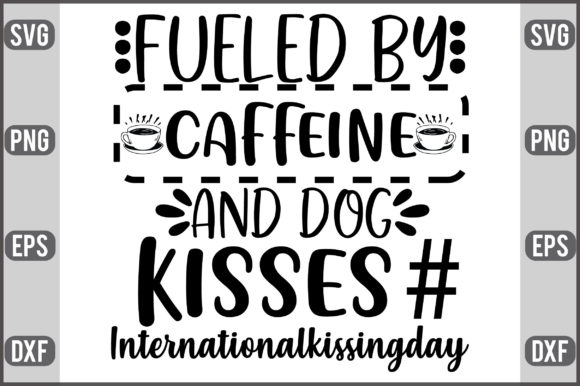
Fueled by Caffeine and Dog Kisses
As a designer who’s stitched hundreds of custom projects—from boutique aprons to Etsy bestsellers—I opened Fueled by Caffeine and Dog Kisses expecting charm, but what stood out immediately was its quiet confidence. It doesn’t shout. It leans in. The layout balances playful energy with clean readability: soft curves in the lettering, a subtle nod to hand-drawn warmth, and just enough whimsy in the “dog kisses” phrasing to feel personal—not cutesy, not forced. This isn’t a design that fights your fabric; it partners with it.
What It Actually Looks Like When Stitched
I tested Fueled by Caffeine and Dog Kisses on a medium-weight cotton tote bag—my go-to for client gift launches—and the result landed exactly where I hoped: warm, authentic, and unmistakably handmade. The phrase flows naturally across a 4” x 6” hoop space, with generous letter spacing that prevents fill-stitch bleed on tighter weaves. No tiny serifs or fragile ligatures to vanish mid-stitch. That’s critical. I’ve seen too many “cute quote” designs collapse under satin stitch pressure—especially on textured fabrics like canvas or terry cloth. Fueled by Caffeine and Dog Kisses avoids that trap. Its weight distribution feels intentional: slightly heavier on the “Fueled” and “Dog,” lighter on “and” and “Kisses”—a visual rhythm that translates beautifully into stitch density.
Where It Shines (and Where It Needs Care)
This embroidery file excels in relaxed, lifestyle-driven contexts: embroidered sweatshirt cuffs, baby onesie hems, linen pillow covers for dog-loving clients, or tea towels for small-batch kitchen brands. As a machine embroidery design, it’s forgiving on stable fabrics—think midweight knits, quilting cotton, or twill—but I’d pause before using it full-size on ultra-stretchy jersey or thin rayon without added stabilizer. The curves hold up well, but dense satin-stitched letters can torque lightweight fabric if hooping tension isn’t dialed in.
For caps or curved surfaces? Scale down to 3” wide max and confirm your digitizing software handles the arc adjustment cleanly—this file doesn’t include pre-arched versions, so you’ll need to adapt it manually. On dark fabric, contrast is strong with standard 40-weight thread, but avoid pale pastels unless you’re adding white underlay. And while the design reads clearly at 3.5”, I wouldn’t push it below 2.75” on a finished product—the “i” dot and tail of the “g” start losing definition.
A Real Project Moment: The Dog Lover’s Gift Bundle
Last month, I built a holiday bundle for a local pet boutique: matching embroidered sweatshirts, organic cotton bandanas, and mini canvas totes—all branded with Fueled by Caffeine and Dog Kisses. Customers didn’t just buy the items—they paused, smiled, and said things like, “That’s *so* me.” That emotional resonance matters. It’s why this works as more than decoration: it functions as gentle brand storytelling. For Etsy sellers or craft fair vendors, that kind of instant connection builds trust faster than any product description. It also photographs well in natural light—no harsh outlines or pixelated edges—making printable mockups and social previews feel cohesive and professional.
Practical Notes Every Embroidery Designer Should Check
- Test first. Run it on scrap fabric matching your final project’s weight and stretch—even if it’s “just cotton.” Thread tension shifts subtly between batches.
- Review stitch density. This design leans moderate—not sparse, not heavy—so it holds up to light washing, but avoid high-heat drying on delicate items like baby onesies.
- Confirm hoop size compatibility. At full width (approx. 5”), it fits standard 5x7 hoops comfortably, but double-check your machine’s maximum stitch area before loading.
- Inspect small details in black-and-white. Some screens mute contrast—view the PNG and SVG side-by-side to spot any unintended gaps or overlapping paths.
- Stabilizer choice matters. Use medium-weight cutaway for knits, tear-away for stable wovens. Skip lightweight fusible unless you’re doing quick-test runs—it won’t support the letter curves long-term.
- Licensing clarity is non-negotiable. Since this is a digital embroidery file sold as a graphics download, verify whether commercial use (e.g., selling finished embroidered patches or apparel) is permitted. The listing says “DIGITAL DOWNLOAD ONLY”—but check the seller’s terms before scaling for your craft business.
Why It Works for Small Shops—and Why It Doesn’t Try Too Hard
Fueled by Caffeine and Dog Kisses succeeds because it respects the maker’s time and the buyer’s taste. It’s not trying to be everything—a monogram, an applique design, a multi-color scene. It’s one focused idea, executed with restraint. That makes it versatile: swap thread colors to match a nursery palette, pair it with a simple paw print for a baby embroidery set, or layer it subtly beneath a larger logo on a boutique apron. It supports your brand instead of competing with it.
For creative entrepreneurs building recognizable collections, this design fits seamlessly into a “lifestyle line”—think coffee + pets + slow living. It adds personality without overwhelming. And unlike trend-chasing phrases that feel dated by spring, this one has staying power. People don’t outgrow caffeine or dogs.
Final Thought: A Design That Feels Like a Conversation
In a sea of over-digitized, over-complicated embroidery files, Fueled by Caffeine and Dog Kisses stands out by listening—to fabric, to stitch behavior, to the quiet joy of a well-placed phrase. It’s the kind of embroidery project that reminds you why you started stitching in the first place: to make something that feels human, real, and quietly joyful. Whether you're prepping for a craft fair, launching an Etsy shop, or gifting a friend who texts you photos of their dog mid-coffee-break—this design earns its place in your library. Just remember: test it, trust your stabilizer, and let the phrase do the work it was made to do.