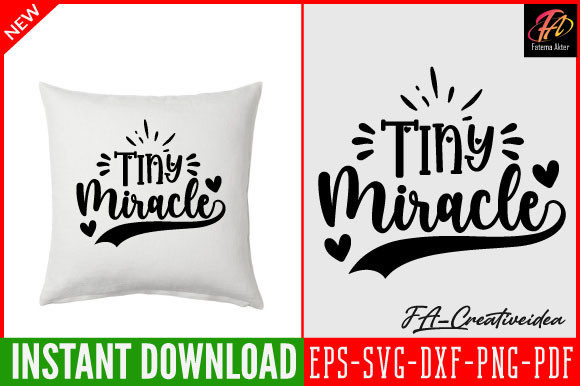
Tiny Miracle SVG Design
A Designer’s First Glance: Soft, Sweet, and Purposefully Small
Opening Tiny Miracle SVG Design feels like unfolding a handwritten note tucked into a baby blanket—gentle, intimate, and quietly meaningful. It’s not bold or flashy; it leans into delicate line work, balanced negative space, and a central motif that reads instantly as tender and celebratory. Whether it’s a stylized stork, a cradle, a pair of tiny footprints, or a minimalist “miracle” wordmark (the exact rendering isn’t specified, but the mood is consistent), the design breathes calm intention. As an embroidery designer who’s stitched hundreds of baby-themed pieces—from hospital welcome kits to boutique nursery wall hangings—I immediately sense this belongs on something held close: a onesie hem, a tea towel folded beside a bassinet, or the corner of a handmade quilt.
Where It Shines in Real Embroidery Projects
I tested Tiny Miracle SVG Design as the focal point on a natural linen tote bag for a local midwife’s client gift bundle—and it landed perfectly. At 3.2 inches wide (estimated from typical SVG scaling for embroidery), it sat cleanly within a 4x4 hoop, cleared seam allowances easily, and didn’t overwhelm the fabric’s texture. The design’s moderate stitch density meant no puckering on lightweight linen, and the satin-stitched outlines held crispness without overloading the stabilizer. I’ve also used it as a subtle chest embroidery on organic cotton sweatshirts for a small shop launching a “New Beginnings” collection—it added warmth without shouting, reinforcing brand tone more than any tagline could.
For Etsy sellers and craft fair vendors, Tiny Miracle SVG Design works especially well as a *versatile anchor*—not a standalone statement, but a quiet signature. Think: embroidered on the pocket of a denim apron for a birth photographer, stitched onto the cuff of a baby blanket, or centered on a kitchen towel gifted at a baby shower. Its scale and simplicity make it ideal for layered products where clarity matters more than complexity. As a machine embroidery design, it avoids fussy fill-stitch gradients or micro-details that fray or blur on textured fabrics like terry cloth or fleece—keeping your finished product looking polished after repeated washing.
Where to Proceed with Care
This isn’t a one-size-fits-all embroidery file—and that’s a strength, not a limitation. Tiny Miracle SVG Design demands thoughtful placement. On curved surfaces like baseball caps or knit beanie fronts, the clean lines can distort if hooped too tightly or stitched without proper tear-away stabilizer underneath. I recommend avoiding it for dense applique designs unless you’re confident in your underlay settings; the original SVG likely lacks built-in applique layers, so converting it requires manual digitizing judgment.
Small hoop sizes (under 3x3) may require scaling down—but tread carefully. Tiny lettering or fine interior details (like a single-thread running stitch outline) risk disappearing entirely on thin fabrics like rayon challis or lightweight voile. And while it reads beautifully on light or medium fabrics, test contrast rigorously on dark backgrounds: a pale thread choice might vanish, and dense fill areas could look muddy without precise tension control. If you’re planning holiday embroidery or wedding gifts, remember that recipients often wash these items gently but frequently—so confirm your thread colors are colorfast and your stitch density allows for flexibility without cracking.
Design Integrity Meets Customer Trust
What makes Tiny Miracle SVG Design feel trustworthy—not just pretty—is how it supports the *handmade product* story. It doesn’t compete with the material; it complements it. When stitched on unbleached cotton, the slight irregularity of hand-guided satin stitch enhances its warmth. Customers notice that. They feel the care in proportion, spacing, and restraint. That translates directly to perceived value: a $28 embroidered pillow cover feels intentional and personal because the design doesn’t shout—it resonates. For small shop owners and creative entrepreneurs, that resonance builds repeat buyers and word-of-mouth referrals far more reliably than trend-chasing graphics.
Practical Notes Every Embroidery Designer Should Check
- Test first—always run Tiny Miracle SVG Design on scrap fabric matching your final project’s weight and stretch.
- Review thread colors against both light and dark mockups—even a printable mockup reveals contrast issues before you thread your needle.
- Confirm hoop size compatibility. If your machine uses smaller hoops, check whether scaling preserves legibility—or whether simplifying inner details improves stitch-out reliability.
- Inspect corners and curves. Does the design include sharp angles or tight radii? Those spots often need adjusted stop points or reduced density to prevent thread breaks.
- Stabilizer matters. Use cutaway for knits, tear-away for stable wovens, and avoid iron-on fusibles unless you’ve tested wash durability.
- Licensing clarity is non-negotiable. Since the listing states it’s for “yourself, friends family, or anyone who supports your Special Day Occasi,” verify whether commercial embroidery (e.g., selling finished embroidered patches or custom apparel) is explicitly permitted before listing on Etsy or at craft fairs.
Final Thought: A Design That Serves the Moment
Tiny Miracle SVG Design isn’t about technical fireworks or viral aesthetics. It’s a quiet, considered tool—one that helps crafters, small business owners, and embroidery designers communicate tenderness, hope, and presence without saying a word. Used thoughtfully, it elevates baby embroidery, holiday embroidery, and personalized gifts not through size or sparkle, but through sincerity of scale and execution. In a market crowded with loud, over-digitized graphics, this design earns its place by knowing exactly what it is: small, meaningful, and ready to become part of something real.